Core farm operations stay on-site through the Coreceiver, so irrigation and monitoring do not depend on constant internet access.
Layered farm-control architecture
How AgroLync works.
Local control first. Remote access when available.
AgroLync is built in layers. The Coreceiver stays close to the farm, field devices handle real equipment, and operators access a clean dashboard from a local HMI, tablet, phone, or secure remote session.
✥ Login to AgroLync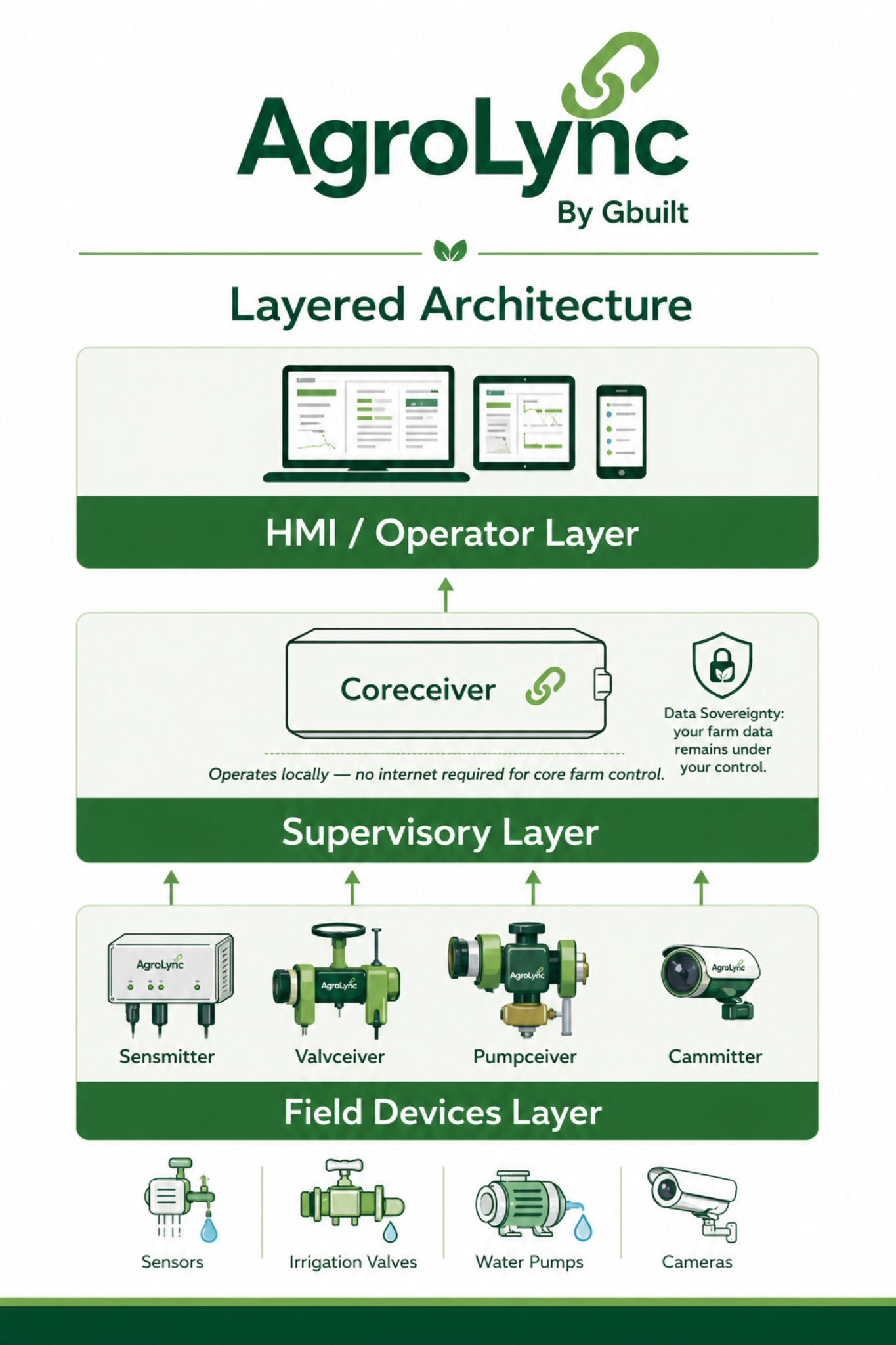
A farm system that keeps working close to the field.
AgroLync avoids a cloud-only design. The Coreceiver can operate locally, collect sensor readings, manage schedules, and communicate with field devices even when internet service is unavailable.
When internet is available, users can access their dashboard through a controlled login and routing path without exposing field devices directly.
Farm data can be stored and handled locally first, keeping the farmer in control of their own operational information.
The AgroLync layers
Each layer has a clear job, making the system easier to understand, troubleshoot, and scale.
HMI / Operator Layer
The user-facing dashboard is available from a monitor, tablet, or phone. Operators can view sensors, maps, schedules, pumps, valves, and alerts from one practical interface.
Supervisory Layer
The Coreceiver acts as the brain of the farm. It receives field data, stores information, runs local logic, and provides the dashboard connection.
Field Devices Layer
Sensmitters, Valvceivers, Pumpceivers, and Cammitters connect the system to real-world equipment such as sensors, irrigation valves, water pumps, and cameras.
Equipment Layer
The bottom layer is the physical farm equipment: soil sensors, pressure sensors, valves, pumps, tanks, cameras, and other devices installed across the field.
Built for farms that cannot depend on perfect internet.
AgroLync keeps the critical control path close to the farm while still allowing secure remote visibility when connectivity is available.